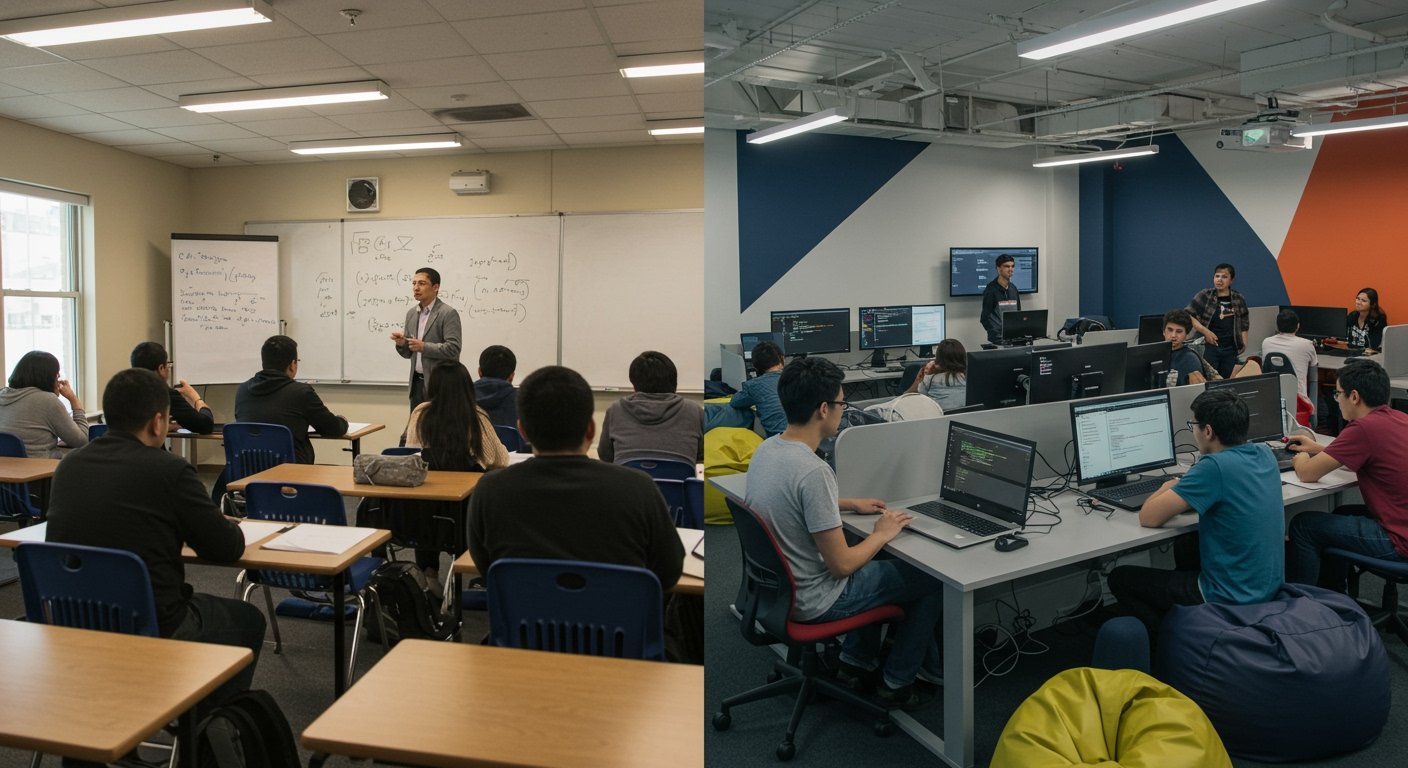
The conventional wisdom goes like this: get a four-year computer science degree, land an internship, graduate into a cushy tech job. That was the playbook. But somewhere along the way, bootcamps emerged promising to compress four years into four months—and now nearly half of tech job postings don’t even require a degree.
So which path actually gets you hired in 2026?
Here’s the uncomfortable truth that neither camp wants to admit: the answer depends almost entirely on factors that have nothing to do with the education itself. Your financial situation, your existing skills, your target role, your local job market, and frankly, your tolerance for risk all matter more than whether a CS professor or bootcamp instructor taught you JavaScript.
This isn’t a “both are valid” cop-out. By the end of this article, you’ll have a concrete framework for making this decision—and you might be surprised which path makes more sense for your specific situation.
The Real Numbers: What 2026 Data Actually Shows
Let’s cut through the marketing spin from both sides.
Bootcamp Outcomes
According to Course Report’s 2025 market survey, 79% of bootcamp alumni land programming jobs within six months, reporting an average 51% salary increase over their pre-bootcamp income. The median starting salary sits around $70,698, with top programs like Ada Developers Academy reporting $117,000 average starting salaries for graduates funneled into corporate apprenticeships.
But here’s what bootcamp marketing won’t tell you: that 79% figure includes people who already had tech-adjacent experience. The job market for true career changers—someone coming from retail or hospitality with zero technical background—is significantly tougher. During the challenging 2023-2024 hiring cycle, even top-tier bootcamps like Codesmith saw placement rates dip to 62-70% for full-time roles, with job searches stretching to a full year.
| Bootcamp Outcome | 2024-2025 Data |
|---|---|
| Employment rate (6 months) | 79% |
| Average starting salary | $70,698 |
| Top program salaries | $110,000-$117,000 |
| Salary increase over pre-bootcamp | 51% |
| Median job search time | 1-6 months |
| Challenging market placement | 62-70% |
CS Degree Outcomes
Computer science graduates start at approximately $80,000+, with median mid-career salaries reaching $123,400. According to the Bureau of Labor Statistics, computer and information technology occupations are projected to grow 22% from 2023 to 2033—far faster than average.
The catch? CS graduates carry an average of $38,000 in student loans, and the four-year investment means four years of foregone salary. That opportunity cost matters more than most people calculate.
{.comparison}
| Factor | Bootcamp | CS Degree |
|---|---|---|
| Time investment | 3-6 months | 4 years |
| Average cost | $13,584 | $43,676 (public) - $154,032 (private) |
| Starting salary | $70,698 | $80,000+ |
| ROI breakeven | 14-18 months | 5-7 years |
| Job placement (6 mo) | 79% | Varies by internship |
The ROI Calculation Nobody Shows You
Most bootcamp-vs-degree comparisons present simplified numbers that miss the full picture. Let’s run the real math.
The Bootcamp Path
Year 1 costs:
- Bootcamp tuition: $13,584 (average)
- Living expenses during program: ~$5,000-15,000 (3-6 months without income)
- Total investment: ~$20,000-30,000
Year 1-2 earnings:
- Starting salary: $70,698
- Total earnings after 2 years: ~$145,000
5-year cumulative earnings minus costs: ~$325,000-350,000
The CS Degree Path
4-year costs:
- Tuition (public, in-state): $43,676
- Opportunity cost (4 years @ $40,000/year median): $160,000
- Total investment: ~$203,000
Year 5-6 earnings (post-graduation):
- Starting salary: $80,000
- Total earnings after 2 working years: ~$165,000
5-year cumulative earnings minus costs: ~$-38,000 (still in the hole)
Wait—did the bootcamp graduate just come out $350,000+ ahead over five years?
This is why the ROI breakeven for bootcamps averages 14-18 months, while degree holders don’t catch up until year 7-10 in most scenarios. The bootcamp path offers dramatically faster payback.
But there’s a critical caveat: this assumes the bootcamp graduate lands a job quickly and doesn’t plateau. That’s where the degree advantage kicks in long-term.
Where Degrees Still Win (And It’s Not Where You’d Think)
The degree premium isn’t about starting salaries. It’s about career ceiling.
Access to Specialized Roles
Certain positions functionally require a CS degree:
- Machine learning engineer
- Computer vision specialist
- AI research roles
- Compiler development
- Quantitative finance
- Most R&D positions at FAANG companies
If you’re targeting these roles, the bootcamp path requires years of self-study to fill fundamental gaps in algorithms, data structures, and theoretical computer science that bootcamps simply don’t cover.
The VP Track
Here’s something career discussions rarely mention: executive technical roles (VP of Engineering, CTO) at established companies still overwhelmingly go to degree holders. Not because the degree taught them leadership—it’s a credentialing signal that persists despite the “skills-based hiring” trend.
If your ambition extends beyond individual contributor roles to leading large engineering organizations, the degree provides optionality that’s difficult to replicate.
Visa Considerations
International students face an additional constraint: H-1B visa applications for tech roles are significantly smoother with a bachelor’s degree. Bootcamp credentials, while professionally valid, create immigration complications that can derail career plans.
Where Bootcamps Dominate
Speed to Income
The math above already shows this, but it bears emphasizing: if you need to change careers within 6-12 months, a degree is not an option. Period.
A 35-year-old career changer with a mortgage and kids cannot go back to school for four years. A bootcamp followed by aggressive skill-building through platforms like freeCodeCamp and project work is the only viable path. Our guide on how to switch careers to IT covers this transition in depth.
Practical, Current Skills
Bootcamps teach what employers need right now: React, Node.js, Python, cloud deployment. Meanwhile, CS programs often teach theoretical concepts using Java or C++ with curricula that lag industry trends by years.
The r/cscareerquestions subreddit is littered with CS graduates who can explain Big O notation but can’t deploy a web application. Bootcamp graduates ship on day one.
Lower Risk, Faster Pivot
If you invest $15,000 and 4 months into a bootcamp and discover you hate coding? That’s an expensive lesson, but a recoverable one. If you spend 4 years and $150,000 on a CS degree and realize software engineering isn’t for you? That’s a decade of financial recovery.
The Skills-Based Hiring Shift
Here’s the trend that’s reshaping this entire conversation:
According to CompTIA’s Workforce and Learning Trends 2024, almost half of all tech job postings no longer specify a four-year degree requirement. An analysis of tech job listings in early 2025 showed that 62% now include phrases like “degree or equivalent practical experience”—up from just 38% in 2020.
Major employers have explicitly removed degree requirements:
- Google offers positions for non-degree holders including IT Support Specialists, Data Analysts, and Digital Marketing roles
- Amazon/AWS removed degree requirements from over 500 job requisitions in 2023 alone
- Apple, IBM, and Microsoft have all publicly committed to skills-based hiring
According to LinkedIn’s 2025 Skills-Based Hiring Report, 83% of organizations now prioritize skills over traditional qualifications, and nearly 60% of employers in tech sectors have hired candidates without degrees in the past year.
This shift makes bootcamps more viable than ever—but it doesn’t mean degrees have become worthless. It means demonstrable skills matter more than credentials of either type.
The Decision Framework: 9 Questions to Answer
Rather than telling you what to choose, here’s the framework that actually works. Score yourself honestly.
1. How Old Are You?
- Under 22: Degree makes more sense (time is on your side)
- 22-30: Both viable; depends on other factors
- Over 30: Bootcamp likely wins on ROI
2. What’s Your Financial Situation?
- Can afford 4 years without income: Degree an option
- Need income within 6-12 months: Bootcamp only
- Have significant savings: More options
3. What Role Do You Want?
- Web/mobile developer: Bootcamp works great
- Data science: Either works; bootcamp needs supplementation (see our data analyst career path)
- ML/AI research: Degree strongly preferred
- Management track: Degree provides long-term advantages
4. Do You Have Technical Aptitude Already?
- Already comfortable with logic and problem-solving: Bootcamp can accelerate
- Need to build fundamentals from scratch: Degree provides better foundation
- Strong self-learner: Either works with supplementation
5. What’s Your Local Job Market?
- Major tech hub (SF, NYC, Austin, Seattle): Both work
- Secondary market: Bootcamp may require relocation or remote work
- Rural area: Remote-first approach regardless
6. How Risk-Tolerant Are You?
- Need guaranteed outcomes: Neither provides this, but degrees have longer track record
- Comfortable with uncertainty: Bootcamp’s faster iteration allows pivots
7. What’s Your Learning Style?
- Need structure and accountability: Bootcamp’s intensity helps
- Self-directed and independent: Self-study might beat both
- Prefer depth and theory: Degree aligns better
8. What’s Your Support System?
- Can live with family during transition: More options
- Solo with high fixed costs: Speed matters more → bootcamp
9. What’s Your Backup Plan?
- Bootcamp doesn’t lead to job: Can you self-study more, or will you need to pivot careers again?
- Degree and hate it: Are you committed for 4 years regardless?
The Third Path Nobody Talks About
Here’s what the bootcamp vs. degree debate misses: the best outcomes often come from neither path in isolation.
The community on r/learnprogramming has converged on a pattern that outperforms both:
- Start with free resources - freeCodeCamp, The Odin Project, or Codecademy to validate interest
- Build 2-3 real projects that solve actual problems
- If needed, add a bootcamp for structure, networking, and career services
- Fill gaps with targeted learning - CS50 for fundamentals, LeetCode for interview prep
- Land the first job - then continue learning on the job
This hybrid approach captures bootcamp speed with degree depth, typically at lower cost than either standalone path.
For hands-on Linux and terminal skills, platforms like Shell Samurai let you practice real command-line work in your browser—a skill gap many bootcamp and degree programs leave unfilled. Building a home lab is another excellent way to gain practical experience that impresses employers.
What Employers Actually Think
Beyond the statistics, here’s what hiring managers consistently report:
What Gets You In the Door
- Strong portfolio with 3-5 real projects
- Contributions to open source
- Ability to explain your code and decisions
- Evidence of continuous learning
- Relevant internships or freelance work
What Gets You Rejected
- Inability to code during technical interviews (regardless of credential)
- No projects beyond coursework
- Can’t explain CS fundamentals when asked
- Poor communication skills
- Obvious credential-chasing without genuine interest
Notice what’s missing from both lists? Neither “has a CS degree” nor “completed a bootcamp” appears as a deciding factor. The credential gets your resume seen; the skills get you hired.
According to industry data, approximately 69% of employers consider bootcamp graduates as worthy additions to their staff based on demonstrated skills and knowledge. Bootcamp graduates compete effectively with traditional CS degree holders—when they can demonstrate equivalent abilities.
Making It Work: Path-Specific Advice
Whichever path you choose, here’s how to maximize success.
If You Choose Bootcamp
Before the bootcamp:
- Complete 100+ hours of free coding tutorials to confirm interest
- Learn basic programming concepts before paying tuition
- Research bootcamps thoroughly—our bootcamp ranking guide covers the options
During the bootcamp:
- Treat it like an 80-hour/week job
- Start networking immediately; don’t wait until graduation
- Build projects beyond the curriculum
After the bootcamp:
- Apply to 10+ jobs daily during the job search
- Continue learning data structures and algorithms
- Contribute to open source to build credibility
- Consider remote IT positions to expand your options
If You Choose Degree
During college:
- Complete 2-3 internships (non-negotiable for employment)
- Build projects outside of coursework
- Contribute to research if targeting specialized roles
- Learn modern frameworks the curriculum skips
Maximizing ROI:
- Consider community college for first two years ($3,000-5,000/year vs. $10,000-50,000)
- Work part-time in tech-adjacent roles or entry-level IT positions
- Graduate in 3 years if possible via summer courses and AP credits
If You Choose the Hybrid Path
First 3 months:
- 200+ hours of freeCodeCamp or Codecademy
- Complete 1 substantial project
- Evaluate whether to continue self-taught or add structure
Months 4-9:
- Bootcamp if needed for accountability/career services
- Otherwise, The Odin Project full curriculum
- Build portfolio site with 3-5 projects
Months 10-15:
- Intensive job search
- LeetCode and HackerRank for interview prep
- Continue filling gaps with Coursera or Udemy courses
The Skills That Matter Regardless of Path
Whether bootcamp or degree, employers consistently want:
Technical fundamentals:
- At least one language deeply (JavaScript, Python, or similar)
- Database design and SQL
- Version control (Git)
- Basic algorithms and data structures
- Understanding of web architecture
For solid programming language guidance, check out our comprehensive breakdown.
Practical abilities:
- Can ship working software
- Debugs systematically
- Writes readable, maintainable code
- Learns new technologies quickly
- Communicates technical concepts clearly
Career skills:
- Technical interview preparation
- Salary negotiation
- Networking and personal branding
- Continuous learning mindset
The Uncomfortable Truth About Both Paths
Neither a bootcamp nor a CS degree guarantees employment. Both require significant additional effort beyond the classroom.
The bootcamp graduate who stops learning after graduation will plateau quickly. The CS graduate who never builds real projects will struggle to land interviews. The credential is the starting point, not the finish line.
What actually differentiates successful outcomes:
- Persistence - The job search takes longer than anyone expects
- Continuous learning - Tech skills depreciate; you must keep updating (see in-demand technical skills)
- Networking - Most jobs come through connections, not applications
- Genuine interest - People who code because they enjoy it outpace those who just want the paycheck
Real Talk: The Current Job Market
It would be irresponsible to write this article without acknowledging: the entry-level tech job market in 2024-2025 has been brutal.
Layoffs at major tech companies, AI automation concerns, and economic uncertainty have made landing that first role harder than any time in the past decade. Bootcamp graduates are reporting 6-12 month job searches that would have been 2-3 months in 2021.
This doesn’t mean bootcamps don’t work—it means expectations need calibrating. The 79% employment rate is real, but “within six months” might stretch to “within twelve months” in the current environment.
The same pressures affect CS graduates. The days of signing a $150K offer before graduation are over for most. Competition is fierce regardless of credential.
This is precisely why the skills over credentials trend matters more than ever. When hundreds of applicants compete for each role, having a bootcamp certificate OR a CS degree doesn’t differentiate you. Having demonstrable skills and a strong portfolio does.
So, Which Should You Choose?
If you’ve read this far, you probably have a gut feeling already. Trust it, with these considerations:
Strongly consider a bootcamp if:
- You’re over 25 with existing financial obligations
- You’re targeting web development, DevOps, or general software engineering roles
- You need income within 12 months
- You’re a self-motivated learner who will continue after graduation
- You’ve already validated interest with 50+ hours of free tutorials
Strongly consider a degree if:
- You’re under 22 with minimal financial obligations
- You’re targeting ML/AI, research, cybersecurity, or eventually executive roles
- You can secure internships (they matter more than the degree itself)
- You want optionality for specialized fields
- International visa considerations apply
Strongly consider the hybrid self-taught path if:
- You’re disciplined enough to learn without external structure
- You’re extremely cost-conscious
- You already have some technical background
- You’re comfortable with longer timeline uncertainty
Whatever you choose, remember: the education is just the beginning. Every successful software engineer—bootcamp, degree, or self-taught—got there through years of continuous learning beyond their initial training. For more on certification paths, explore our IT certifications topic hub.
The credential opens doors. What you build after that determines where you go.
Frequently Asked Questions
Do employers prefer CS degrees over bootcamp graduates?
Not as uniformly as you might think. According to recent data, approximately 69% of employers consider bootcamp graduates as worthy hires based on skills. For entry-level roles, demonstrated ability matters more than credential. For senior and specialized roles, degree holders often have advantages in theoretical foundations.
Can I get a job at Google/Amazon/Meta without a CS degree?
Yes—all three companies have publicly removed degree requirements from many positions. Google, Amazon, Apple, IBM, and Microsoft have all committed to skills-based hiring. However, competitive positions at these companies remain challenging regardless of credential, and having a strong portfolio and interview skills matters most.
What’s the average bootcamp cost in 2026?
The average bootcamp costs approximately $13,584, though prices range from $2,500 to $21,000. Free options exist, including 42, Ada Developers Academy, and programs offered through freeCodeCamp.
How long does it take to get a job after a bootcamp?
The median time is 1-6 months, though the current job market has stretched this for some graduates. Career services intensity, local job market, and individual effort significantly impact placement speed. Top bootcamps report 79-96% placement within six months.
Is self-teaching a viable alternative to both?
Absolutely, for the right person. Many successful developers are entirely self-taught using free resources like freeCodeCamp, The Odin Project, and CS50. The challenge is maintaining momentum without external accountability. A hybrid approach—self-teaching plus selective bootcamp or courses—often works best.
Sources and Citations
- Bureau of Labor Statistics - Computer and IT Occupations
- Course Report - Coding Bootcamp Market Survey 2025
- CompTIA Workforce and Learning Trends 2024
- LinkedIn Skills-Based Hiring Report 2025
- Best Colleges - Coding Bootcamp vs Computer Science Degree
- Research.com - Is Computer Science Degree Worth It 2026
- Nucamp - Are Coding Bootcamps Worth It 2025
- Top Companies Hiring Without Degrees 2025